Proud Teacher Everyday SVG: A Designer’s Review
As an embroidery designer who has spent countless hours digitizing and testing files for real-world application, I approach every new machine embroidery design with a critical eye. It is not enough for a graphic to look good on a screen; it must translate seamlessly into thread, holding up under the tension of the needle and the texture of the fabric. Recently, I evaluated the Proud Teacher Everyday SVG Design to determine its viability for commercial and personal projects. This review breaks down how this asset performs when moved from a digital concept to a tangible, stitched reality.
First Impressions and Visual Personality
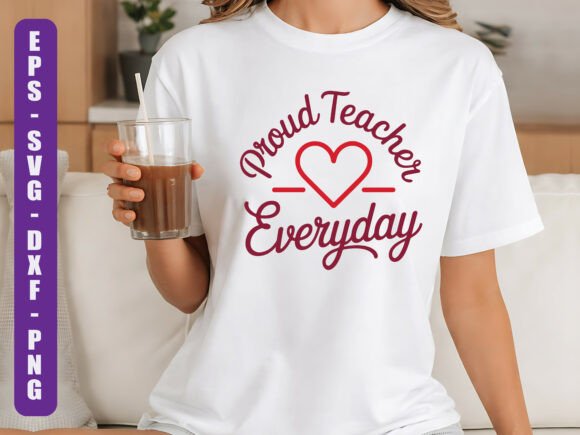
The initial appeal of the Proud Teacher Everyday SVG Design lies in its balanced composition. For those of us working in the niche of educator appreciation, finding designs that avoid cliché while maintaining instant recognizability is a challenge. This design manages to strike a friendly, professional tone. The layout suggests a clean, modern aesthetic that appeals to contemporary tastes rather than outdated, overly ornate styles.
When viewing the source files, which are categorized under T-Shirt Designs and Graphics, one must mentally convert vector lines into stitch paths. The shapes appear solid and well-defined, which is a positive indicator for embroidery. Complex, thin lines often disappear or break during stitching, but the visual weight here suggests it can handle conversion into satin stitch borders or fill stitch areas without losing integrity. The mood is celebratory yet understated, making it versatile for various contexts beyond just the classroom.
Real-World Application: The Tote Bag Test
To truly understand the value of an embroidery file, I imagine it in a specific production scenario. Let us consider a custom order for a local boutique: a set of heavy-canvas tote bags for a school’s end-of-year staff gifts. This is a common request for Etsy sellers and craft business owners. The Proud Teacher Everyday SVG Design would serve as the central focal point on the front panel.
In this context, the design’s scale is crucial. On a standard tote, you have ample room for a larger hoop, allowing the details to breathe. The text elements, assuming they are part of the SVG structure, need to be scrutinized for legibility. If the lettering is too thin, it may require careful digitizing to ensure the thread colors pop against the canvas. I envision using a high-contrast thread palette—perhaps navy or forest green on natural cotton—to enhance readability. The result would be a durable, high-value handmade product that feels substantial and thoughtful, far exceeding the perceived value of a printed alternative.
Adapting for Apparel and Accessories
Beyond totes, this design shows promise for custom apparel. Imagine it embroidered on the left chest of a teacher’s cardigan or the back of a sweatshirt embroidery project. For apparel, the flexibility of the design is key. If the original SVG is dense, it might feel stiff on a lightweight shirt. However, if adapted correctly, it can become a subtle badge of pride.
For baby embroidery items, such as a onesie or a burp cloth, the design would need significant scaling down. This is where caution is required. Small details in SVGs do not always translate well to small hoop sizes. If the design includes intricate elements, they may merge into a blob of thread when shrunk. I recommend testing a scaled-down version on scrap fabric to ensure the stitch density does not pucker the delicate knit fabric. For caps and hats, the curved surface presents another challenge; the design must be narrow enough to fit within the typical cap frame without distorting.
Technical Considerations for Stitching
While the Proud Teacher Everyday SVG Design is marketed towards print-on-demand platforms like Merch by Amazon and Redbubble, embroidery artists must bridge the gap between print and stitch. SVGs are vector graphics, meaning they are resolution-independent, but they are not stitch files. You cannot load an SVG directly into most embroidery machines without conversion software or manual digitizing.
This distinction is vital for digital embroidery file users. If you are purchasing this as a graphic resource to digitize yourself, look for clean paths and closed shapes. If you are expecting a pre-digitized file, verify the format. Assuming you are converting this SVG, pay attention to corner sharpness. Sharp corners in vectors often require specific underlay stitches and tie-offs in embroidery to prevent unraveling.
Furthermore, consider the fabric texture. On textured towels or waffle-weave fabrics, fine details can get lost. In such cases, simplifying the design or increasing the stitch width might be necessary. Always use the appropriate stabilizer. For stretchy fabrics like t-shirts, a cut-away stabilizer is essential to prevent the design from warping after washing. For woven fabrics like aprons or pillow covers, a tear-away may suffice, depending on the stitch density.
Commercial Viability and Brand Consistency
For small shop product creators, consistency is brand currency. The Proud Teacher Everyday SVG Design offers a cohesive look that can be integrated into a broader collection. Whether used for holiday embroidery gifts during Teacher Appreciation Week or as part of a back-to-school lineup, the design’s neutral yet positive tone allows it to pair well with other assets.
When creating printable mockup images for your online store, ensure the digital representation matches the stitched reality. Misleading previews can lead to customer dissatisfaction. Use the SVG to create high-quality visuals, but clearly label the final product as embroidered. This transparency builds customer trust and enhances the perceived professionalism of your design assets.
Practical Designer Notes
- Test on Scrap Fabric: Never run a new design on your final garment without a test stitch-out. Check for thread breaks and tension issues.
- Check Thread Contrast: Ensure your chosen thread colors stand out against the fabric. Low contrast can make the design illegible from a distance.
- Review Stitch Density: If digitizing from the SVG, avoid excessive density which can cause puckering, especially on thinner materials.
- Confirm Hoop Size: Measure the design dimensions against your machine’s maximum hoop capacity before starting.
- Inspect Small Details: Zoom in on the SVG to identify any tiny elements that may not stitch out cleanly and consider removing or enlarging them.
- Licensing Verification: Since this bundle is created for POD platforms, carefully read the license terms. Confirm whether the SVG can be used for physical embroidered goods or if it is restricted to digital prints. This is crucial for commercial embroidery projects.
Final Verdict
The Proud Teacher Everyday SVG Design is a strong candidate for educators’ merchandise, provided the user understands the transition from vector to thread. It offers a professional, heartfelt aesthetic that resonates with the target audience. For embroidery designers and makers, it serves as a solid foundation for creating high-quality personalized gifts and finished products. By paying attention to technical details like stabilizer choice, stitch density, and fabric compatibility, you can transform this graphic into a standout piece that enhances your portfolio and delights your customers. Always prioritize practical testing over assumptions, and let the quality of your stitching speak for the value of your craft.